

What Search Console now tells you about AI answers
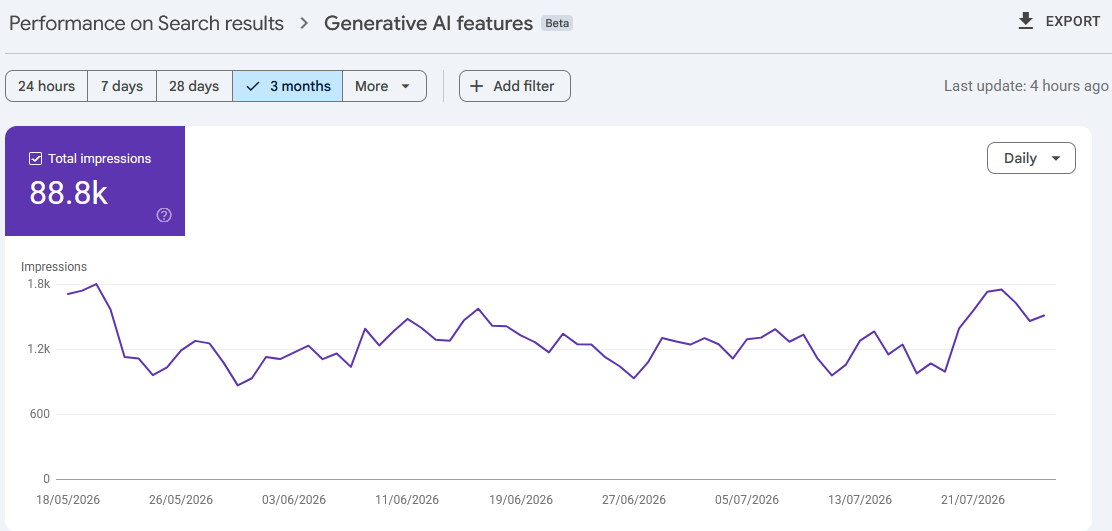
If you use Google Search Console and your website has enough traffic, you might have started seeing graphs like this. And it’s a bit shocking to see it presented this way. For those who don’t know, Search Console (formerly Google Webmaster Tools) is the place to go to find out how much traffic you’re getting – or not – from Google search results, including which pages are visited the most and crucially which search queries (so-called keywords) led them to your page.
What is so different about this graph is that it’s missing one element that’s always been most important to anyone investing time and money in making a website: clicks.
There have always been two key indicators of success in search: clicks and impressions. The value of an impression is dubious depending on the nature of your business and has become more so over time for reasons too dull to go into here. But what it means conventionally is that one of your pages has appeared somewhere in a page of search results (although it may or may not have been seen and may or may not have been clicked).
An impression is like having a shop in the High Street. A click is like having someone step through the door. It’s certainly not a guarantee of selling something (and what we call “bounce rate” tells us that most people probably won’t), but it’s an opportunity.
The ratio between impressions and clicks tells you the click-through rate. Or, to stretch the analogy, the percentage of passers-by who stopped and came in the shop. Typically, for a successful site this might once have been somewhere between 1% and 3% on average. But that is changing. And not in a good way.
I’m not here to bemoan the arrival of Google’s AI Overview, which is the new normal in search results. It’s much more productive to focus on getting my clients into that space than complaining that it exists. But it’s telling that the beta version of Google’s stats is showing us impressions and not clicks. I suspect there’s one very good reason for that: revealing the number of clicks from the AI Overview tells us the click-through rate, and it’s going to be much, much lower than we have been used to.
Having said that, I remain confident that the AI Overview and its ilk will be very positive for some websites. It’s arguably better than being in the top three search results – always considered to be the Holy Grail of SEO – because coverage in the AI Overview is presented as expert advice. Google is no longer telling you “Here’s a list of pages – pick one you like the look of”. It’s telling you: “The page you need is this one” and showing its reasoning.
For a lot of search results, the enquiry will end there, which is why clicks are plummeting. But if someone is a potential customer looking for a supplier, they will inevitably click. And that means you’re getting a lead on a customer who is predisposed to buy from you because (accurately or otherwise) Google has presented itself as an authority on who is the best in your business.